




Classroom Mathematics California: A comprehensive TK-8 mathematics curriculum organized around the Try–Discuss–Connect instructional framework, combining problem-based learning, integrated language development, and print and digital resources to support instruction and assessment.

Between the Greens

Classroom Mathematics California (CMC)

Categories

Explore curriculum

Program Organization

Classroom Mathematics California is a comprehensive mathematics curriculum organized around consistent instructional routines and a clearly sequenced progression of mathematical ideas. Every lesson follows the Try–Discuss–Connect framework. This problem-based approach incorporates multiple routines into daily instruction while integrating language to develop deeper understanding. The program includes print and digital instructional resources, assessments, and planning tools that support ongoing monitoring of student learning.

Quick Overview

Reviewed by EdReports*
Meets Expectations for Alignment & Usability
Core Materials Printed
Student Digital Platform
LMS Integration
Illustrative Math Derivative
TK Program
Algebra 1/Math 1 Aligned
Full High School Aligned
Spanish Teachers' Edition

Design Highlights & Considerations

Design Highlights

Access & Scaffolds

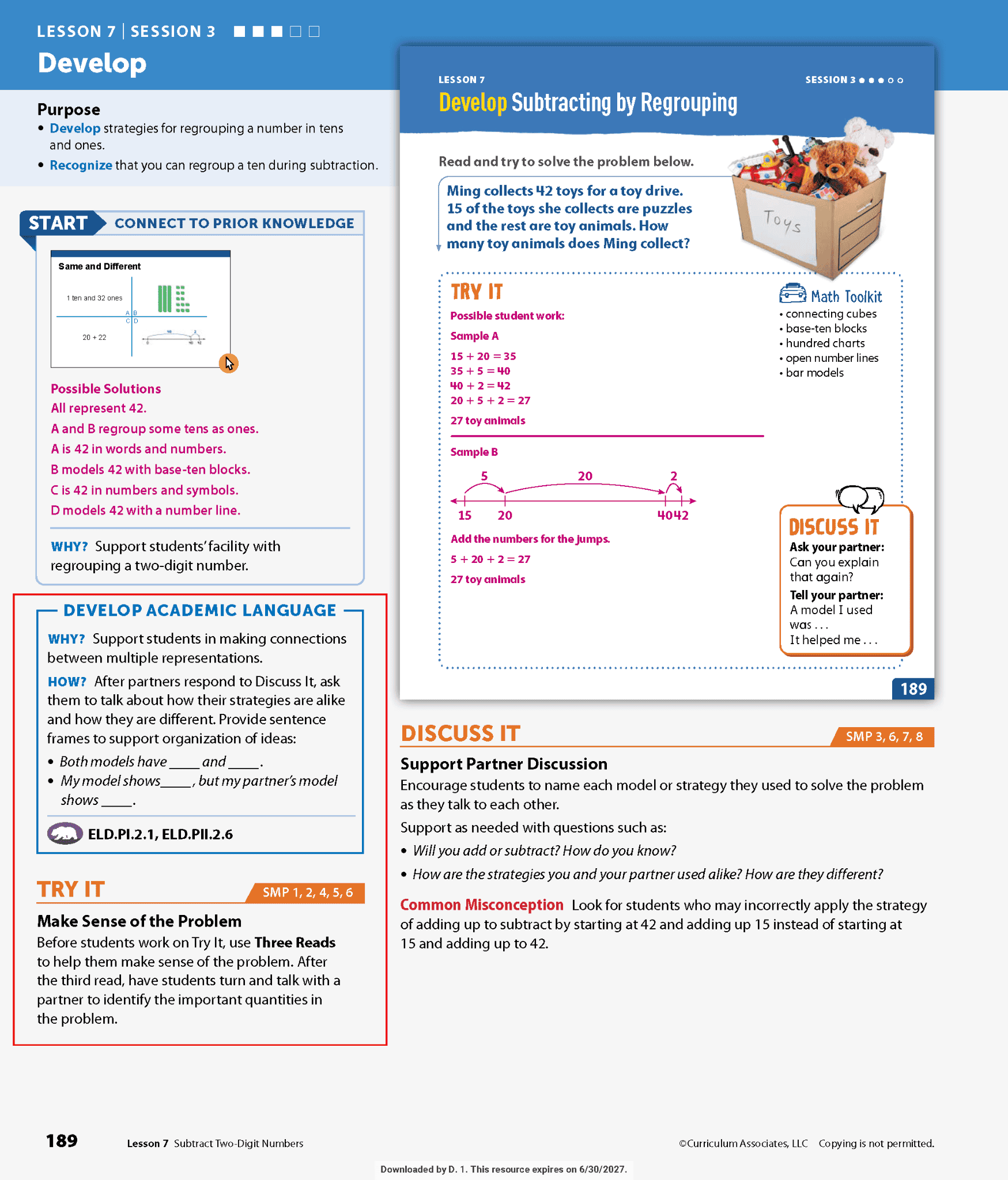
Classroom Mathematics California (CMC) embeds math language routines directly within each session, though they are not explicitly labeled as Mathematical Language Routines (MLRs). Sentence frames and structured discourse supports are integrated into teacher instructions at the session level. CMC also uses Language Development Proficiency Levels in each session. UDL is woven into the program through a separate, formal UDL planning toolkit that sits alongside the core lessons which supports intentional barrier analysis and instructional planning.
Example+

Open Tasks

Classroom Mathematics California (CMC) reflects the CA Math Framework’s vision by developing students’ ability to apply mathematical concepts through contextual problem launches, modeling tasks, and recurring opportunities to represent, analyze, and justify their reasoning. Across daily sessions and extended Data Investigations, students interpret situations, use diagrams, tables, and equations to model relationships, and defend conclusions using evidence from data or representations.

Assessment Tools

Classroom Mathematics California (CMC) provides a comprehensive assessment system that aligns to the Big Ideas and supports both formative and summative purposes through lesson quizzes, unit assessments, performance tasks, self-assessment and standards-based mastery checks. Students can demonstrate understanding through written explanation, modeling, reflection pages, oral presentations, and rubric-guided performance tasks, with built-in self-assessment and peer-feedback structures. The digital platform (i-Ready) extends assessment through diagnostics, progress monitoring, and standards reporting, while small-group differentiation tools (reteach, reinforce, extend) connect assessment data directly to instructional next steps.

Teacher Planning & Knowledge

Classroom Mathematics California (CMC) provides a clear instructional roadmap through comprehensive unit, lesson, and session planning tools, supported by an extensive digital platform that enables teachers to plan instruction, assign materials, analyze student work, and access embedded professional learning. Each lesson integrates “Professional Learning” articles and a detailed “Math Background” that unpacks Big Ideas, learning progressions, key visuals, misconceptions, and error alerts, strengthening teachers’ pedagogical content knowledge and supporting just-in-time instructional decisions.

Considerations

Lesson structure

Lessons are organized within a structured, step-by-step flow that includes early scaffolds and guided models. Districts may wish to examine how this structure affects opportunities for extended exploration and sustained productive struggle within and across lessons. District review teams might look closely at how long students engage in open reasoning before formalization.

Breadth of tools

The breadth of digital tools, embedded resources, and planning components may require intentional onboarding to ensure teachers can navigate and prioritize materials effectively. District review teams should examine how easily teachers can locate, prioritize, and adapt materials within the platform. Consider the level of professional learning needed for effective implementation.

Professional Learning

The breadth of digital tools, embedded resources, and planning components may require intentional onboarding to ensure teachers can navigate and prioritize materials effectively. District review teams should examine how easily teachers can locate, prioritize, and adapt materials within the platform.


To learn more about Professional Learning offerings for this program, please visit the publisher website and view the California Professional Learning Partner Guide (PLPG) which provides a vetted list of top organizations offering high-quality, curriculum-aligned professional learning services.

For a deeper look, consult the program profile

Compare this Curriculum

Classroom Mathematics California (CMC) Curriculum Associates

For Districts That Need…

Lesson-level language objectives, embedded ELD alignment, and visible supports for Multilingual Learners.
An instructional framework that has been aligned to CA Drivers of Investigation, Standards for Mathematical Practice, and Content Connections.
An assessment system (iReady) that aligns to the Big Ideas and provides mastery tracking across lessons & units.
Structured lesson flow with clear scaffolds and embedded teacher guidance.

Ensure You Are Planning For…

Time and professional learning to onboard teachers into the digital platform.
Clear expectations about timing and pacing flexibility within a structured lesson design.

AI Summary

Both IMKH and Classroom Mathematics California are aligned to the California Math Framework and support conceptual understanding and mathematical reasoning, but they differ in structure and implementation design. The strongest choice will always depend on local needs, professional learning structures, the level of instructional coherence already in place and the evidence collected during the review.

AI-generated content is intended to support exploration, not replace district evaluation.

Methodology

Methodology Note

Between the Greens is designed to present narrative, expert-informed profiles of highly rated curriculum options. These do not evaluate effectiveness, assign ratings, or make adoption recommendations and should be considered alongside local priorities and additional committee review.

This report was created independently and was not written or sponsored by curriculum publishers.